




Auditor Career Path in Australia: From Graduate to Audit Partner

Rezonate Recruitment • June 24, 2026

If you are exploring an audit career path in Australia, the progression is usually clear: start as a graduate auditor, build technical and client-facing experience, move into senior and management roles, then progress toward Audit Director or Audit Partner.


Auditing is a strong career option for accounting professionals who enjoy detail, problem-solving, compliance, client relationships, and understanding how businesses operate. In Australia, external auditors help organisations meet financial reporting requirements by reviewing systems, controls, financial information, and audit evidence.
Jobs and Skills Australia describes external auditors as professionals who design and operate reporting systems, procedures, and controls to meet external financial reporting requirements. Common tasks include identifying financial risks, conducting audits and investigations, preparing reports, evaluating operational risks, and designing audit methodologies.


What does an Auditor do?


An auditor reviews financial records, systems, controls, and processes to check whether financial information is accurate, compliant, and reliable.


In public practice, this often means working as an external auditor for clients across different industries. External auditors act independently, helping provide confidence to shareholders, boards, investors, regulators, and other stakeholders.


Audit work is guided by the
Australian Auditing Standards. These standards support auditors in obtaining reasonable assurance, exercising professional judgement, maintaining professional scepticism, identifying risks of material misstatement, gathering audit evidence, and forming an opinion on the financial report.


Typical auditor career path in Australia


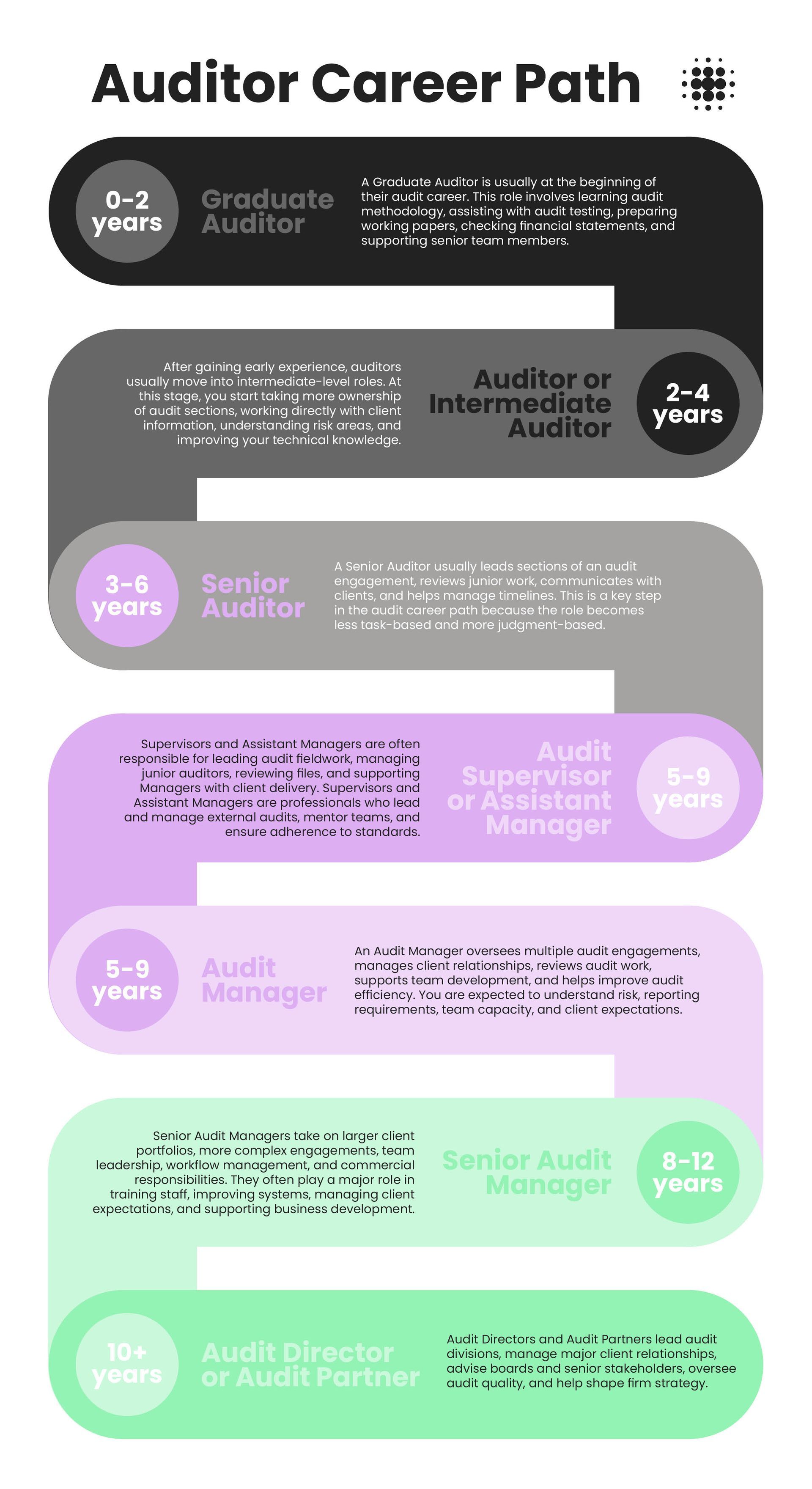
The most common auditor career path in an Australian accounting firm looks like this:


Graduate Auditor


A Graduate Auditor is usually at the beginning of their audit career. This role involves learning audit methodology, assisting with audit testing, preparing working papers, checking financial statements, and supporting senior team members.


Most graduate auditors have completed, or are completing, a commerce, business, accounting, or finance degree. Jobs and Skills Australia data shows that 52.1% of external auditors hold a bachelor's degree, while 25.3% hold a postgraduate, graduate diploma, or graduate certificate qualification.


Auditor or Intermediate Auditor


After gaining early experience, auditors usually move into intermediate-level roles. At this stage, you start taking more ownership of audit sections, working directly with client information, understanding risk areas, and improving your technical knowledge.


This is where many auditors begin professional study, such as the CA Program or CPA Program. For example, CA ANZ lists Audit and Assurance, Financial Accounting and Reporting, Business Law, Taxation, Finance, and other competence areas as part of its academic entry requirements for the CA Program.


Senior Auditor


A Senior Auditor usually leads sections of an audit engagement, reviews junior work, communicates with clients, and helps manage timelines. This is a key step in the audit career path because the role becomes less task-based and more judgment-based.


At this level, firms expect stronger technical knowledge, clear communication, confidence with clients, and the ability to identify issues before they become bigger problems.


Audit Supervisor or Assistant Manager


Supervisors and Assistant Managers are often responsible for leading audit fieldwork, managing junior auditors, reviewing files, and supporting Managers with client delivery. Supervisors and Assistant Managers are professionals who lead and manage external audits, mentor teams, and ensure adherence to standards.


This stage is important because it tests whether you enjoy leadership, delegation, and client management, not just the technical side of audit.


Audit Manager


An Audit Manager oversees multiple audit engagements, manages client relationships, reviews audit work, supports team development, and helps improve audit efficiency. You are expected to understand risk, reporting requirements, team capacity, and client expectations.


This is also the point where long-term career direction becomes clearer. Some auditors continue toward Senior Manager and Partner. Others move into commercial accounting, financial reporting, internal audit, risk, governance, consulting, or corporate finance.


Senior Audit Manager


Senior Audit Managers take on larger client portfolios, more complex engagements, team leadership, workflow management, and commercial responsibilities. They often play a major role in training staff, improving systems, managing client expectations, and supporting business development.


This role is a stepping stone to Director or Partner for auditors who want a leadership career in public practice.


Audit Director or Audit Partner


Audit Directors and Audit Partners lead audit divisions, manage major client relationships, advise boards and senior stakeholders, oversee audit quality, and help shape firm strategy.


To be appointed as an auditor of companies and certain entities in Australia, you generally need to become a Registered Company Auditor with ASIC. ASIC requires applicants to demonstrate appropriate qualifications and skills, capability, and fit and proper status. ASIC’s registration pathway includes qualification requirements, such as accounting and auditing studies, and skills requirements, such as approved competency standards or practical audit experience. The prescribed practical experience pathway requires at least 3,000 hours of auditing work under the direction of a Registered Company Auditor within the five years before application, including at least 750 hours supervising company audits.


How long does it take to become an Audit Partner?


There is no fixed timeline, but many auditors spend more than a decade building the experience needed for partnership. Progression depends on technical ability, professional qualifications, leadership skills, client relationships, business development ability, and opportunities within the firm.


A simple pathway may look like:

  • Graduate Auditor: 0 to 2 years
  • Auditor or Intermediate Auditor: 2 to 4 years
  • Senior Auditor: 3 to 6 years
  • Assistant Manager or Manager: 5 to 9 years
  • Senior Manager: 8 to 12 years
  • Director or Partner: 10+ years


These timeframes are general only. Some people progress faster, while others move sideways into internal audit, risk, commercial finance, or advisory roles.


Is auditing a good career in Australia?


Yes, auditing can be a strong career in Australia, especially for accounting professionals who want structured progression and broad commercial exposure. Jobs and Skills Australia reports around 12,500 external auditors employed in Australia, with the largest shares based in New South Wales, Victoria, and Queensland.


Audit also builds highly transferable skills. You learn financial reporting, risk assessment, controls, professional scepticism, client communication, documentation, and leadership. These skills are valued in public practice, corporate finance teams, internal audit, governance, and risk roles.


Building your audit career


If you want to grow your audit career, focus on three things: technical skill, communication, and long-term direction.


Early in your career, build strong audit fundamentals and complete your professional study. As you move into senior roles, focus on leading files, reviewing work, managing clients, and mentoring juniors. If your goal is partnership, you will also need commercial awareness, relationship-building skills, and the ability to bring value to both clients and the firm.


At Rezonate Recruitment, we connect auditors with firms that value technical ability, growth, culture, and long-term career progression. Whether you are a Graduate Auditor, Senior Auditor, Audit Manager, or future Partner, the right firm can make a major difference to your next step.


FAQs: Audit career path in Australia


What is the usual audit career path in Australia?

The usual audit career path is Graduate Auditor, Auditor, Senior Auditor, Supervisor or Assistant Manager, Audit Manager, Senior Audit Manager, then Audit Director or Audit Partner.


Do auditors need to be registered in Australia?

You can work in audit teams while building your experience, but to be appointed as an auditor of companies and certain entities, you generally need to be registered with ASIC as a Registered Company Auditor.


What degree do you need to become an Auditor?

Most auditors study accounting, commerce, business, or finance. Many also complete CA or CPA studies as they progress.


Can Auditors move out of public practice?

Yes. Auditors commonly move into internal audit, risk, governance, commercial accounting, financial reporting, advisory, or finance leadership roles.

By Rezonate Recruitment May 29, 2026
Is there still an accountant shortage in Australia? Explore the future of accounting in Australia, the roles in highest demand, salary trends, and what it means for candidates and employers.

By Rezonate Recruitment April 30, 2026
Explore the best accounting and business support certifications in Australia, including CA, CPA, SMSF, payroll, Xero, BAS, and admin courses.

By Rezonate Recruitment April 29, 2026
Discover Rezonate Recruitment’s people-first approach to accounting and business support recruitment for candidates and firms across Australia.

By Rezonate Recruitment April 28, 2026
When accounting firms are hiring, it’s easy to assume the decision comes down to technical skills. Qualifications, experience, and technical ability are all important, and they’re often what gets a candidate through the door. But they’re rarely what makes the final decision. From our experience working with firms across Australia, hiring managers are looking for something more well-rounded. 1. It’s Not Just Technical Skills Communication is one of the biggest factors. Accounting is a client-facing profession, and firms need people who can explain concepts clearly, build relationships, and represent the business well. A technically strong candidate who struggles to communicate effectively will often be overlooked for someone who is slightly less experienced but more confident with clients. Another key factor is how candidates approach their work. Firms value people who take ownership, show initiative, and think beyond the task in front of them. This doesn’t mean having all the answers, but it does mean being proactive, asking the right questions, and showing a genuine interest in improving. Consistency also plays a role. Hiring managers look for steady progression in a candidate’s career. They want to see growth, increasing responsibility, and a clear trajectory over time. It’s not about having a perfect CV, but rather showing that you’ve developed your skills and taken on new challenges as you’ve progressed. 2. Attitude and Cultural Fit Matter More Than You Think Attitude is another area that often gets underestimated. Candidates who are open to learning, adaptable, and positive in their approach tend to stand out quickly. These are the people firms see as long-term hires, individuals who can grow into leadership roles and contribute to the wider team culture. Cultural fit is just as important. Every firm operates differently, and hiring managers are looking for people who align with their way of working. This includes everything from communication style and team dynamics through to values and expectations. A candidate might look perfect on paper, but if they don’t align with the firm’s culture, it can create challenges down the line. 3. How You Present Yourself Makes the Difference For candidates, this means it’s important to think beyond your technical skillset when preparing for opportunities. How you present yourself, how you communicate your experience, and how you demonstrate your value all play a significant role in how you’re perceived. Being able to clearly explain your impact, not just your responsibilities, can make a strong difference. It’s also worth remembering that hiring is a two-way process. Just as firms are assessing you, you should be assessing them. The goal isn’t just to secure an offer, it’s to find a role where you can grow, feel supported, and build a long-term career. If you’re unsure how you come across in the market, or what firms are really prioritising right now, getting an external perspective can be incredibly valuable. We offer free consultations, no strings attached, if you want to get honest advice from a team that helps firms hire every day. Just reach out to us , we're always happy to help. Often, a few small adjustments in how you position yourself can significantly improve your opportunities.
By Rezonate Recruitment April 28, 2026
Most people don’t wake up one day and decide they need a new job. In reality, the decision builds over time. At Rezonate, a large portion of the candidates we speak to weren’t actively job hunting when we first connected. They were simply curious. Something didn’t feel quite right, or they wanted to understand what else was out there. That’s usually the first sign. So, what are the signs it's time to move? Sometimes it’s obvious. You might feel underpaid compared to your peers, overworked without recognition, or stuck in the same role with no clear progression. In these cases, the decision to move can feel straightforward. Other times, it’s more subtle. You might notice your motivation dropping, even though nothing major has changed. You’re doing the same work, in the same environment, but it no longer feels engaging. You might also find yourself questioning your long-term future at the firm, without having a clear reason why. These moments are easy to ignore, but they’re often worth paying attention to. A simple way to sense-check where you’re at is to ask yourself a few honest questions. Are you still learning and developing your skills? Do you feel valued by your team and leadership? Is there a clear next step for you within your current firm? If the answer to most of these is no, it doesn’t necessarily mean you should resign tomorrow. It does, however, suggest it might be time to explore your options. Exploring other options Exploring the market doesn’t lock you into anything. In fact, it usually does the opposite. It gives you clarity. When you understand what roles are available, what firms are offering, and what your profile is worth, you’re in a much stronger position to make an informed decision. That might mean staying where you are with a renewed perspective, or it might mean taking the next step in your career. Another important point to consider is timing. Many professionals wait until they feel completely ready to move before having conversations. By that stage, they’re often frustrated or burnt out, which can lead to rushed decisions. Having conversations earlier allows you to stay in control and approach the process more thoughtfully. It also helps you build relationships with recruiters and firms before you actually need to make a move. Where to go from here Ultimately, changing roles is a big decision, and it’s not one that should be taken lightly. But staying in a role that no longer aligns with your goals can have a long-term impact on your growth and satisfaction. If you’ve started questioning what’s next, that’s usually a sign worth exploring. Even a simple conversation can give you the clarity you need to decide what the right move looks like for you. Get in touch with our team if you want some honest advice and insights into the current market.